
One source of anxiety and anguish is uncertainty about where one should be. Should I stay where I am, or try to move forward? Should I be content with my situation, or never be satisfied? Which is better — ambition or acceptance?
Is what I have enough? Is what I do enough? Can I rest without guilt?
An interesting answer is embedded in the very names of this week's combined Torah portions, Matot and Masei. Matot, means "tribes"; Masei, means "journeys." Matot opens with Moses addressing the heads of the tribes, and Masei begins with a recounting of the 42 journeys the Jewish people made during their 40 years in the desert on the way to the Promised Land.
Leaving the actual content aside, the contrast between the two names is itself striking and instructive.
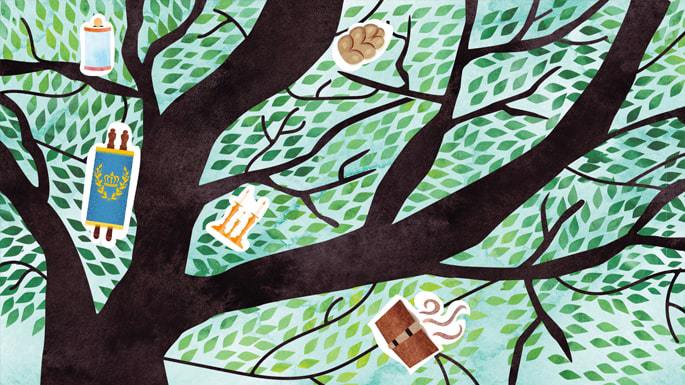
The Torah uses two words for "tribe": mateh (plural: matot) and shevet (plural: shevatim). Both also mean "branch." The difference: a shevet is a branch still connected to the tree, or freshly cut and still flexible. A mateh is a branch that has been detached, dried out, and hardened.
Isn't it strange, then, to pair a name suggesting rigidity and rootedness (Matot) with one that suggests constant movement (Masei)?
Herein lies the key to answering the question we posed at the outset. There is no contradiction between stability and movement. In fact, each depends on the other. Stability should not be confused with stagnation, and growth has nothing to do with instability. On the contrary: genuine growth is possible only when grounded in stability. Constant movement without roots produces neither stability nor real growth.
This apparent conflict arises often when people feel they must choose between their ancient traditions and the changing values of the modern world. Many frame it as a choice between stagnation and progress: "Do I hold on to the traditions of the past, or move with the current of the present?"
But is that really the choice? Must we disconnect from our roots to enter the future?
The dual name of this week's parshah suggests another perspective: the two are not opposites but complements, even mutually dependent. Real progress is possible only from a strong foundation. Without roots, there is no genuine progress, only floating. You may have the sensation of movement, but you are being carried by the current, not generating movement yourself.
A halachic example comes to mind.1 For meat to be kosher, the animal must come from an acceptable species and must be healthy. One criterion for health: if an animal has fallen from a height, we check whether it might be fatally injured. For a four-legged animal or a chicken, the check is whether it can walk a certain distance without difficulty. For a duck, there is an additional option: it is placed in a river. If it swims against the current, it is healthy and kosher. But it is also kosher if it swims with the current — provided it moves faster than a stick placed alongside it. This shows it is not merely being carried by external force, but is generating its own movement.
The true sign of progress is when you can move forward under your own power. Movement driven by external currents is more a symptom of personal stagnation.
The tool for this week: Work on two things simultaneously: 1) strengthen your connection to your own essence; 2) work to express the unique and novel contribution that only you can offer. For that, you need to be well-connected — like a phone that can only navigate when it has power.
P.S. After writing these lines, I experienced something that illustrates the concept perfectly. I got into the car to visit a friend. My smartphone battery was low, so I plugged it into the car charger to use the GPS. To my horror — the cable didn’t work! Fortunately, I had another one and was able to continue the journey. You see? To move forward, you need to be well connected.


Start a Discussion